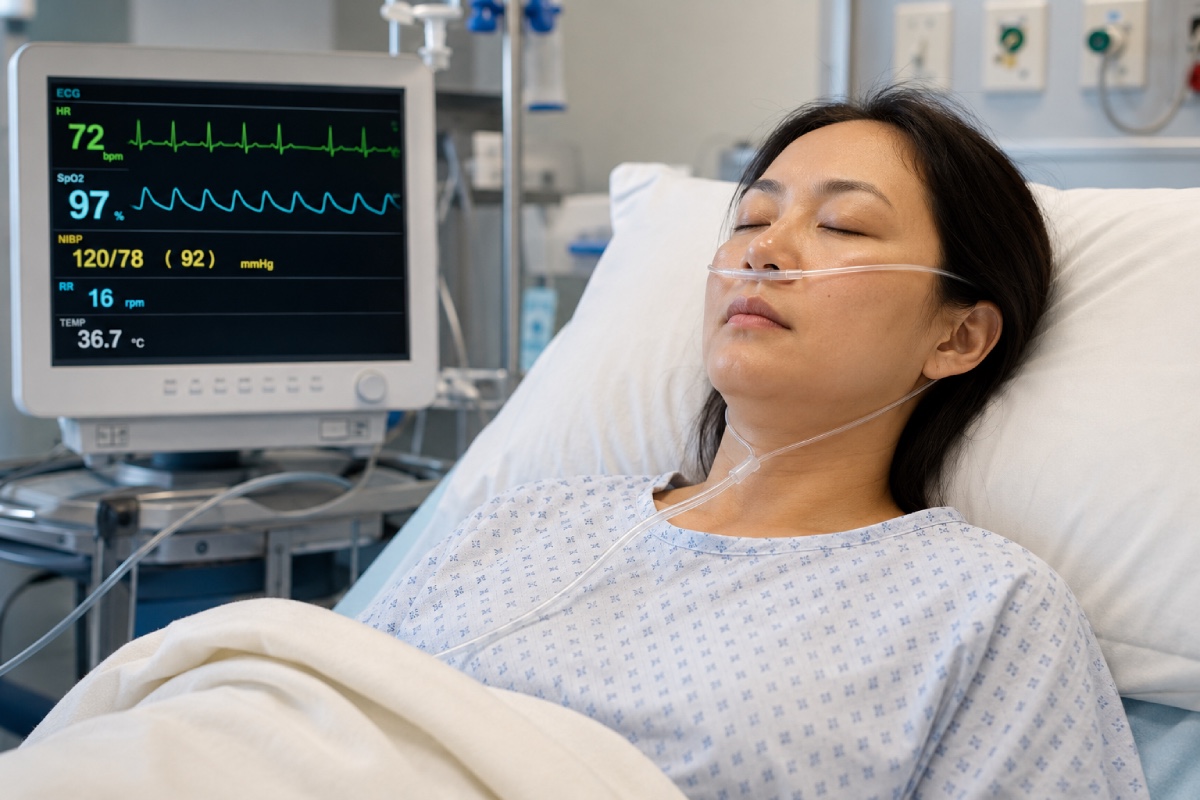
According to modern best practices, oxygen administration in the post-anesthesia care unit (PACU) is a titrated therapy directed at preventing hypoxemia while avoiding unnecessary oxygenation. Postoperative patients may be vulnerable to oxygen desaturation because residual anesthetic and neuromuscular blocking effects, opioids, atelectasis, impaired upper-airway tone, pain-limited ventilation, shivering, and ventilation–perfusion mismatch may converge during early recovery. Supplemental oxygen can provide a safety buffer, but routine or excessive oxygen may impair detection of hypoventilation and contribute to hyperoxemia-related respiratory and cardiovascular effects.¹ As a result, administering supplemental oxygen in the PACU and determining the necessary flow rate should be based on the individual patient’s condition.
Routine high-flow oxygen in the PACU is not always required, particularly in low-risk patients. One study randomized 293 low-risk postoperative patients to 4 L/min unhumidified oxygen by nasal cannula, 40% oxygen by face tent, coached lung hyperinflations, or no oxygen-enhancing regimen. Only 4% developed oxygen saturation below 90%. The authors concluded that supplemental oxygen was not essential in maintaining adequate oxygen saturation when PACU arrival saturation exceeded 92%.² This finding is clinically important because it supports a selective, monitored approach rather than automatic oxygen escalation in all uncomplicated recoveries.
However, the absence of hypoxemia at one moment should not be mistaken for physiologic stability. Another study used blinded continuous oximetry after noncardiac surgery and found that 21% of patients had SpO₂ values below 90% for at least 10 minutes per hour, 37% had at least one smoothed episode below 90% lasting one hour or longer, and routine nursing records missed most prolonged hypoxemic episodes.³ These data suggest that spot measurements may underestimate hypoxemia burden and that oxygen flow decisions in the PACU should be paired with continuous or frequent assessment, especially before discontinuation or transfer.
Ramachandran et al. further linked PACU oxygenation patterns to outcomes in 125,740 postoperative patients. SpO₂ below 89% and PACU oxygen therapy exceeding 60 minutes were independently associated with early postoperative respiratory complications, including reintubation.⁴ Importantly, prolonged oxygen requirement may be a marker of persistent physiologic risk. A patient requiring oxygen for most of the PACU stay may need closer evaluation for hypoventilation, airway obstruction, residual blockade, opioid sensitivity, atelectasis, or evolving pulmonary pathology.
High-flow nasal cannula (HFNC) oxygen has theoretical advantages, including high flow delivery, humidification, low-level positive airway pressure, and high tolerability, and it has often been used in PACU settings. However, the OPERA trial found that prophylactic HFNC at 50–60 L/min after major abdominal surgery did not significantly reduce postoperative hypoxemia or pulmonary complications compared with conventional low-flow oxygen delivered by nasal prongs or facemask.⁵ HFNC may therefore be appropriate for selected high-risk or failing patients but does not need to be routine PACU practice.
An evidence-based PACU oxygen strategy begins with initial oxygen support for at-risk patients and flow titration to an acceptable SpO₂ range, usually 92–98%. Low-flow nasal cannula oxygen, such as 2–4 L/min, is often suitable for uncomplicated patients who require support, whereas mask oxygen or HFNC should be reserved for greater oxygen requirements, persistent desaturation, respiratory distress, or high-risk physiology.
References
- Suzuki, S. Oxygen administration for postoperative surgical patients: a narrative review. J. Intensive Care 8, 79 (2020). https://doi.org/10.1186/s40560-020-00498-5
- Gift, A. G., Stanik, J., Karpenick, J., Whitmore, K. & Bolgiano, C. S. Oxygen saturation in postoperative patients at low risk for hypoxemia: is oxygen therapy needed? Anesth. Analg. 80, 368–372 (1995). https://doi.org/10.1097/00000539-199502000-00028
- Sun, Z. et al. Postoperative hypoxemia is common and persistent: a prospective blinded observational study. Anesth. Analg. 121, 709–715 (2015). https://doi.org/10.1213/ANE.0000000000000836
- Ramachandran, S. K., Thompson, A., Pandit, J. J., Devine, S. & Shanks, A. M. Retrospective observational evaluation of postoperative oxygen saturation levels and associated postoperative respiratory complications and hospital resource utilization. PLoS ONE 12, e0175408 (2017). https://doi.org/10.1371/journal.pone.0175408
- Futier, E. et al. Effect of early postextubation high-flow nasal cannula vs conventional oxygen therapy on hypoxaemia in patients after major abdominal surgery: a French multicentre randomised controlled trial (OPERA). Intensive Care Med. 42, 1888–1898 (2016). https://doi.org/10.1007/s00134-016-4594-y